10 February 2009

Coyne laments not for the CPoC

... but for conservative political representation. As do I.
Conservatism may not be my thing, but it is for a lot of other people, and I grieve for their sake that the party they have invested so much of their hopes in has turned to such warm beer. And all Canadians, whatever their leanings, should wish for more balance and diversity in our political choices.

I disagree with Coyne on a number of things but on some issues he is dead on.

As much as I loathe the HarperCrites and question the intelligence of their supporters, I don't want to see Canada without principled political representation for Canadian conservatives. Just as I don't want to see so many social libertarians continuing to be left abandoned in the political southwest wilderness.
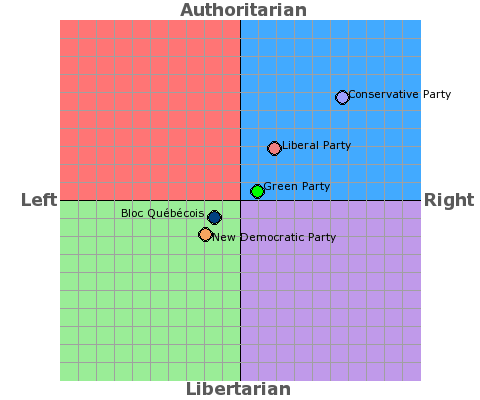


The x axis in the image above represents the economic; the y axis the social. Since the shift of the HarperCons and Iggy's coronation, the two parties have shifted toward each other. The CPoC no longer is as far right, while the LPC has moved both up and to the right.

ALL Canadians should be represented in our political institutions. Which means, of course, that we need proportional representation, another issue on which Coyne and I agree.

And we need PR urgently.

BC is about to have another go-round on PR - on May 12. We'll be voting in a referendum to change our electoral system to the Single Transferable Vote.

All PR advocates, including those who support MMP, should rally to the cause. With a PR system in place, advocates for any other model will not be ignored but instead receive the attention they deserve from provincial politicians and candidates running for office. Under the present non-proportional system we have politicos can, and consistently do, ignore the majority of voters. After all, it's the minority which lands them their jobs.

Recommend this post

09 February 2009

Harper's Minister Slags Workers

Hey, Canadians, get off your lazy butt and get a job. Quit sitting back and collecting YOUR employment insurance.
Federal Human Resources Minister Diane Finley has explained why she, and presumably the Harper government, is opposed to raising employment insurance payments for unemployed workers, or making it easier to qualify. "We do not want to make it lucrative for them to stay home and get paid for it," she said on January 30.

Perhaps some of those lazy, unemployed workers ought to apply for Minister Finley's position. Just about anyone else would be an improvement for the human resources portfolio, one which requires understanding of the complexities facing employers, employees and the (newly) unemployed alike. A little compassion wouldn't hurt either.

Recommend this post

Shades of Things to Come?

Living in Canada, we think nothing like this could ever happen here.
The story line here is familiar from headlines after the U.S. Supreme Court issued a 5-to-4 decision that almost everyone hated. It allowed the destruction of a Connecticut neighbourhood through eminent domain. It said ordinary people would lose their homes to make way for private development. Even a dissenting justice wrote that no property was safe or sacred anymore.

Yet, with the onslaught of land hungry developers wanting to build their idea of utopia, with little regard for the people who have slowly grown into a community, it may become a Canadian reality.

Recommend this post

Canadian Association of Broadcasters cuts staff, president, COO

According to this article, the Canadian Association of Broadcasters needs to rejig its business model and there are musings that the CAB may go the way of the cable TV association - that is, fold altogether.

On January 28th, the CAB announced that

"the renewed organization will operate with reduced resources and a more focused approach to advocacy relating to broadcasting sector policies and copyright matters."

...Charlotte Bell, chair of the CAB board, said that 14 people were leaving the association, including president Glenn O'Farrell and chief operating officer Tina Van Dusen. Other senior management positions affected included people in member and marketing services, regulatory and policy, communications, legal and administration. The association's convention, scheduled for November this year in Vancouver, B.C., was also cancelled.


The CAB is vulnerable to losing memberships. For example,

Canwest Global Communications is looking to sell five TV stations across the country, including CJNT-TV in Montreal, CHCH-TV in Hamilton, CHCA-TV in Red Deer, CHBC-TV in Kelowna and CHEK-TV in Victoria.


Now we all know (at least most progressives do) that CanWest, owned by the Aspers, has become little more than the propaganda organ for the Conservative Party of Canada; so it's interesting to read Tim Powers saying that broadcasting industry changes are "in rough shape" due to

declining advertising revenues and digital television allowing people to choose specialty channels over more conventional television stations.


Powers overlooks the fact the more people, especially young people, are turning off TV altogether. Broadcasters rarely ask why this might be, to whit this clueless comment by Powers:

"Often forgotten in this economic turmoil we are now suffering through is the state of conventional broadcasting," he said. "Broadcasters are making a push to have government themselves understand the magnitude of this challenge, not just the regulator, the CRTC... local TV helps connect and showcase the fabric of the country."


Some local TV does, yes, which is what it SHOULD be about. However, broadcasters such as CanWest (like their southern Fox friends) often serve to DISconnect and drive wedges between people and their communities, and rather than "showcasing" the fabric of the country, they paint it with their own brush and present that painted landscape as reality.

Recommend this post

Healthy Food: At What Price?

Canada Health Food Guide suggests at least 5 -10 servings of fruits and vegetables; 5 - 12 servings of grains; 2 - 3 servings of Meat or alternatives and one serving of dairy -- daily.

However, prices for healthy food in Canada vary a great deal, depending upon where you live.
For example:

* Six apples ranged from 90 cents in Peterborough, Ont., to $7.64 in Rankin Inlet, Nunavut.
* One kilogram of lean ground beef was $13.21 in Ottawa, but only $4.14 in Barrie, Ont.
* A package of whole wheat pasta ranged from $2 in Barrie, Ont., to $7.90 in Regina, and a staggering $11.37 in Dawson, Yukon.

We can blame world economics, we can petition local politicians to ensure there are fair prices for obtaining healthy foods, we can cry in our canned soup OR...

We CAN stimulate local food initiatives in all parts of the country. We CAN encourage small farmers by purchasing their product. We CAN allow food to be grown in unused public spaces and we CAN encourage use of innovative technologies to grow food year round.

Another, alternative, cost/time and environmentally friendly way of eating would be to become vegan.

Recommend this post

626,809 votes prevented due to ID rules

... according to the February 2nd report (PDF) authored by Marc Mayrand, Canada's chief electoral officer.

Voter participation was a significant concern in this election. After encouraging results for the 39th general election, participation by Canadian electors has again decreased, reflecting a tendency found in many modern democracies. This phenomenon seems to result from a variety of contributing factors that need to be better understood and, in my view, will require the leadership of civil society...


Mayrand identifies three areas needing attention: administrative processes, voter identification and political financing rules.

The new voter identification rules in Bills C-31 and C-18 include the requirement for a street or civic address. But 4.4 percent of registered electors haven't such an address. These include people living in rural and northern areas, in which it is common only to have a rural route number or post office box.

Given these concerns, the initial voter identification requirements were amended in Bill C-18, in late 2007. The new legislation (S.C. 2007, c. 37) provides that an elector who shows a piece of identification on which the address is consistent with the information contained on the list of electors will be deemed to have established his or her residence.


But if you are not already on the list of electors and don't have a civic address, you will face problems at your polling station.

But here's where the rubber meets the road: a post-election survey done by Elections Canada indicated that 4 percent of respondents didn't vote because they didn't have the required documentation. Of another 4 percent who showed up without the proper documents, 0.5 percent went home and didn't return to cast their votes.

There were 13,929,093 ballots cast in the 40th General Election. Hence, 626,809 votes were lost due to voter identification issues. The people most likely to have been turned away were those living in rural or northern regions, nursing homes, on the streets or in temporary shelter (homeless) and students.

Recommend this post

08 February 2009

On Protectionism, Globalism and Localism

"Protectionist!" cry the free traders - as they count their corporate welfare cheques.

"Nay, nay!," they scream in headlines from their favourite rags.

"The last thing the world needs in this time of economic 'crisis' is the erection of trade barriers.1 Only globalization can save the day."

So advise those who got us into this mess in the first place. (There are many more candidates, including the Wee Three, but oblivious economists such as those discussed in that Newshour interview make a good start.)

True, protectionism gone to the extreme benefits few and impedes the ability to distribute social justice. But so does globalism and "free" trade. Both philosophies, exercised in their purist forms, will deliver similar results: the few benefiting at the expense of the many.

We need elements of both globalism and localism, the latter focused on developing and sustaining healthy local economies, including food production.

1 From the bottom of the poverty well looking up, I can report that there's not a whole lot of difference between this "crisis" and the one which Daphne and I, and far too many others, have faced every day for years.


Recommend this post

On Corruption: Drugs, Doctors and Doctored Academe

From the New York Review of Books comes a summary of three must-reads:
Recently Senator Charles Grassley, ranking Republican on the Senate Finance Committee, has been looking into financial ties between the pharmaceutical industry and the academic physicians who largely determine the market value of prescription drugs. He hasn't had to look very hard.

Take the case of Dr. Joseph L. Biederman, professor of psychiatry at Harvard Medical School and chief of pediatric psychopharmacology at Harvard's Massachusetts General Hospital. Thanks largely to him, children as young as two years old are now being diagnosed with bipolar disorder and treated with a cocktail of powerful drugs, many of which were not approved by the Food and Drug Administration (FDA) for that purpose and none of which were approved for children below ten years of age...

In June, Senator Grassley revealed that drug companies, including those that make drugs he advocates for childhood bipolar disorder, had paid Biederman $1.6 million in consulting and speaking fees between 2000 and 2007... After the revelation, the president of the Massachusetts General Hospital and the chairman of its physician organization sent a letter to the hospital's physicians expressing not shock over the enormity of the conflicts of interest, but sympathy for the beneficiaries...

Read the whole thing. And get the books - I plan to, once they get to my local library. The tale goes from bad to worse.

Recommend this post

07 February 2009

Free-range politicians good for democracy

An editorial in the Montreal Gazette today brings up a good point, although its conclusion is too wish-washy for my taste.

Liberal leader Michael Ignatieff has been widely criticized for allowing this "one-time" freedom to a few MPs, and we can see why. How will he refuse the next provincial or regional dissident group? Nobody can imagine Premier Jean Charest allowing Geoff Kelley, Lawrence Bergman, Kathleen Weil, and Yolande James - and Pierre Marsan and Jacques Chagnon - to vote against party policy, on say Bill 104...

Canadians would be best served, we believe, if elected leaders broke ranks with their parties somewhat more often... Few matters, after all, really need to be questions of confidence for governments.

...In the long run, individual lawmakers would be more useful if they were not shackled so tightly by party discipline.


While I can't disagree with that, it doesn't go far enough. I'd prefer we had far more independent provincial/territorial and federal representatives. The political careers of Independent MP Bill Casey and former Independent MP Chuck Cadman demonstrate that even with the dominance of party politics in this country, such politicians can influence change.

How much more this would be the case if more people were to run without party affiliation.

Which is one reason I favour the Single Transferable Vote. It appears to be the most friendly of electoral systems to candidates running as independents.

Recommend this post

Iggy's Strategy to Win BC

... won't work if this report is correct.

Nor will British Columbians feel closer to Michael Ignatieff than to, say, Stephen Harper or Jack Layton or Elizabeth May, just because he lived a brief time in BC decades ago. This, despite reporter Steve Chase's spin that Iggy's having taught for two years at the University of British Columbia in the 1970s gives him "more than a passing familiarity with BC."

Two whole years. Back in the 70s. Teaching in the lofty towers of UBC. Pray tell, what did Iggy learn from his experience of our fair province?
"Michael's strongest takeaway from his time in B.C. was the sheer beauty of the province and the magnificence of the mountains," spokeswoman Jill Fairbrother said.

Yea, that's about what I expected.

As for the Liberal strategy for winning BC, according to anonymous party analysts it is "fairly straightforward." (Don't you love the quality of reporting these days?)

Mindful of the recession, they must recruit high-profile candidates with economic credentials. They should once again prepare a B.C.-specific campaign platform to demonstrate an affinity for the province. And, finally, to unite the centre and left-of-centre vote, they must sell the party as the only serious entity capable of defeating the Harper government.

Um, do you see anything in there about grassroots? No?

Well, that's peculiar. Because according to a former BC Liberal candidate, the Liberal Party of Canada has no grassroots, at least not in this province. And a party without dedicated volunteers at the community level is a party which cannot win the hearts and minds of voters.

Recommend this post

Nuclear Disarmament

I'll believe it when it happens, not before, but I so hope this is true:
"We are going to re-engage Russia in a more traditional, legally binding arms reduction process," said an Obama administration official quoted by the Times of London this week. "Nobody would be surprised if the number [of nuclear weapons held by each country] reduced to the 1,000 mark for the post-START treaty."

The talks with Moscow will reopen the 1991 U.S.-Soviet Strategic Arms Reduction Treaty (START), which expires in December. "Under that pact, the two countries have cut their respective stockpiles from roughly 10,000 to 5,000," states the Times of London, adding that the negotiations sought by U.S. President Barack Obama are likely to be "the most ambitious arms reduction talks with Russia for a generation."

"A world without nuclear weapons is profoundly in America's interest and the world's interest," Obama has said.

Yes, well, duh! Still, it's good finally to hear this kind of (meaningful? sincere?) talk from a US President.

Recommend this post

Danny and the Premiers

Danny Williams fears for Canada and believes the cracks in our Confederation have everything to do with the divide and conquer tactics of Harper and his band of merry men.
So why, he wonders, is he virtually the only provincial leader standing up and speaking out... "Everybody's afraid to put their head up," he says, "because they will be penalized."

...Among the other premiers, only Prince Edward Island's Robert Ghiz has voiced support.

"Not a peep from anybody else," Williams says.

At November's first ministers meeting, he says, he was first in line to speak up in support of Ontario receiving aid for the auto industry and spoke out for other provinces on equalization.

"I find it very disappointing," Williams says. "When something punitive, excessive and over-the-top happens to a province, I would expect the other provinces and territories to at least express support."


Why is Williams so alone in this fight? Because he appears to be the only Premier who has taken the job not for the purpose of enhancing his personal bottom line and power base, which are already in excellent shape, but because he cares about his province and its people. On the latter, we can add Gilles Duceppe.

While I disagree that HarperCo is the only reason for popular discontent in this country, I do think Danny Boy makes a number of salient points. Would that the province of BC had such a champion!

Recommend this post

06 February 2009

Social services seize child

... from a small grow-op.

This article has me seething, so much so that I can't think coherently.
A child was apprehended by [the BC] Ministry of Children and Family Development workers after Saanich police busted a small marijuana grow operation near Glanford Park. On Wednesday afternoon, Saanich police descended on a single-family home in the 600 block of Kenneth Street and found a three-room marijuana grow operation with a total of 50 plants. A 26-year-old Saanich woman and two men, aged 28 and 41, were arrested...

So what's got me boiling?

First, I object to marijuana, both its consumption and its production, being illegal. Surely it makes more sense to spend our police resources on going after the real criminals. You know, the ones who commit violence!

Second, and following upon that, I object to a child being removed because her parent(s) were summarily arrested for engaging in an activity which shouldn't be deemed a crime in the first place.

Recommend this post

Selling the Island

A private timber company is selling the Island....to developers.
A major timber company that owns about 11 per cent of Vancouver Island is moving into the real estate market in a big way.

TimberWest Forest Corp. has hired Vancouver property market guru Bob Rennie to help the company sell 54,000 hectares of land — 540 square kilometres — from Victoria to Campbell River.

The eager real estate agent says it is "one of the biggest deal he has ever been involved in" and that he doesn't think there "is anything like this in North America".

The article is written in such a way as to make it sound as if it is going to be nothing but good for the communities whose lands abut the denuded forest acreages.

Alas, the real motive is profit: for the timber company, the real estate agents and the developers. The communities that make up the uniqueness that is Vancouver Island will be no more.

Recommend this post

CanWest Watch!

The Conservative Party of Canada's media organ continues its downward slide.

CanWest Global Communications Corp. is selling E!, its secondary television network. Failing a buyer, the network will be shut down at the end of two months.
The E! network, which has stations in Montreal, Hamilton, Red Deer, Kelowna and Victoria, has been losing money. Offloading the assets would help stem losses at a time when CanWest, burdened by debt, has been at risk of violating lending agreements with its banks.

“In the current economic environment, we believe that our efforts are best focused on the areas of greatest return,” CanWest chief executive officer Leonard Asper said in a statement. He said the company is looking to concentrate its efforts around its main network, Global Television, and its more profitable cable channels, including Showcase, HGTV and the Food Network.

This social libertarian doesn't own a TV. But if she did, she'd be sure NOT to watch Global Television or any of CanWest's "more profitable cable channels."

Recommend this post

Aaaawwww... Koala cools off

From a friend of a friend comes this story and accompanying photos:

It has been so hot in South Australia for over a week... [recording-breaking, climate change causing] 40-plus degrees Celsius everyday, very dry also.

A guy at work lives at Maude. His wife sent him these photos of a little Koala which just walked into the back porch looking for a bit of heat relief.

She filled up a bucket and this is what happened!

This little chap obviously knows about hygiene... Drinks the water first then gets in.

Recommend this post

05 February 2009

Changes to equalization done unilaterally

... and under the table. Or that's the way it appears.
The budget itself made no mention of the proposed amendments, leaving provincial officials, members of the opposition and journalists looking for answers. More than a week after the changes were announced, some spokesmen for the finance department deny any changes occurred, and academics who have spent their lives studying the subject are still unclear on the details.

While the changes themselves are still a subject for debate, the way they were introduced is being soundly condemned.

"If this is legitimate to do, we should have a discussion of this stuff," said Wade Locke, an economics professor at Memorial University and a leading expert on equalization. "You shouldn't have to have a legal degree to go through the minutiae of the budget implementation act to determine what has been done, and then have to have an economics degree in order to understand what it means for each province. There is something fundamentally wrong with that."

"I've never seen anything like it," [said Senator Lowell Murray]. "There's not a line about it in the budget, there's not a line about it in any of the budget documents, there's no communication, there's no letter from any minister here to any minister there."

More HarperCon underhandedness. Sneaking legislative changes under the radar. And the Liberals continue either to be asleep at the wheel or willing alternate drivers. The latter looks to be the case, given Michael Ignatieff's directive to Newfoundland and Labrador MPs to support the budget implementation, which is precisely where these changes are being made.

Recommend this post

Cons Commercialize SSHRC Scholarships

From Budget 2009, p106f (PDF version, English) under section "Further Developing a Highly Skilled Workforce":
Canada’s ability to prosper in today’s global, innovation-driven economy ultimately depends on the skills, knowledge and creativity of Canadians. Further developing a highly skilled workforce and ensuring that this talent is well applied is a priority.

Budget 2009 builds on investments made in the previous two budgets by providing an additional $87.5 million over three years, star ting in 2009–10, to the federal granting councils. This funding will temporarily expand the Canada Graduate Scholarships program, which suppor ts Canada’s top graduate students. This includes $35 million for each of the Natural Sciences and Engineering Research Council of Canada and the Canadian Institutes of Health Research, and $17.5 million for the Social Sciences and Humanities Research Council. These funds will provide for an additional 500 doctoral scholarships, valued at $35,000 each per year for three years beginning in 2009–10, and an additional 1,000 master’s scholarships, valued at $17,500 each for one year, in both 2009–10 and 2010–11. Scholarships granted by the Social Sciences and Humanities Research Council will be focussed on business-related degrees.

Given that scholarships granted by SSHRC are, by definition, awarded to students in the SOCIAL SCIENCES or HUMANITIES, we can assume students will be hard pressed to qualify for said scholarships.

In which case, the $17.5 million set aside for SSHRC is meaningless. Few, if any, graduate students will be able to touch a penny of it.

Recommend this post

Do you care about electoral reform in this country?

Then you should care about what's happening in BC. We may be the last, best hope for proportional representation to gain a foothold in Canada. Our second referendum on the Single Transferable Vote will take place on May 12, at the time of our next provincial election.

When the BC Citizens Assembly in 2004 voted on the system to recommend to British Columbians, STV won by an overwhelming margin. Then, in our May 2005 referendum on STV, 58 percent of voters chose in favour of the reform. In only two ridings of the 79 was the referendum marginally defeated. That result prompted the BC government to hold another referendum, the one coming up in May.

If you care about reform in this country, then you need to follow what's happening here. Please.

Recommend this post

BC NDP and Electoral Reform - P4

Response received. Well, sort of, and perhaps more revealing than intended. None of the questions in my email were answered directly. Here is Carole James' short response, received today, the last sentence the most revealing:
Dear Chrystal Ocean,

As I wrote before, I think this crucial debate is too important to get mired in partisan politics, so I will not be commenting on STV prior to the referendum.

However, I am firmly committed to implementing STV if the referendum passes. And, if it does not pass, I remain committed to offering British Columbians the opportunity to vote on MMP.

Sincerely,

Carole James, Leader
Official Opposition


My legitimate questions concerned what James' party would do about the following issues if it formed the government:
  • the STV referendum, should the result show a clear majority of voters in favour of the reform, but it falls short of the 60 percent threshold imposed by the Liberal government - a threshold supported by the opposition NDP. NB: We achieved 58 percent in favour of STV in 2005 and a majority in all but two of our (then) 79 ridings.
  • quoting James, the "open and democratic process" she would propose to follow "to work for an electoral system that is fair and balanced." I asked her if she would convene a new Citizens' Assembly followed by a referendum with a 60% threshold, or if she would move more directly towards implementing some version of MMP.

BC voters have a right to know the NDP's answers to these and other questions I asked in my follow-up email BEFORE we vote in the election and referendum. Waving the flag of false concern for "partisan politics" to weasel out of answering them doesn't cut it.

With James' final response above, let it be known that I'll not be voting for the NDP in May. I'll also be campaigning HARD to make other voters aware of the party's undemocratic position.

As has been recognized by other feminists and I have written elsewhere, electoral (and democratic) reform both provincially and nationally is the most pressing issue of our time. Without true democratic representation, issues of importance to voters, rather than issues of importance to those in power and their corporate backers, will continue to be ignored.

Recommend this post