As 2010 comes to a close, my hope for the coming decade is for an overhauled Canadian Parliament and similar changes to the BC Legislative Assembly. I doubt anything substantive will change in terms of policy or direction - for this country, this province or its communities - if these changes do not happen.
I hope for the people's representatives to be elected through a new inclusive electoral system; that the powers of back-benchers be returned; that the power in the office of the heads of governments be vastly reduced; and that Question Period, a farce today, be returned to a venue for vital rigourous debate on issues important to Canadians.
I hope for a reversal of the power and responsibilities of Canada’s three tiers of government. Local governments must have more power, greater areas of responsibility and additional means for acquiring their own, direct, revenue. Many Canadians appear, rightly, to have had enough of the paternalism of the federal and provincial governments toward municipalities; the governments closest to the people are those that should have the greatest political power to effect change.
Of the years 2001 through 2010, they constituted the most miserable and worst decade for me personally. The misery was lessened, however, through new friends and learning that this community truly was a ‘community’ in the old-fashioned sense. My rapidly-acquired and subsequently persisting straitened circumstances also came with a silver lining. They forced a reassessment of my values and shoved the activist in me out of the closet. Had my personal circumstances not been so bad I may never have opened my eyes to the distress around me or become such a strong proponent and activist for democratic (and housing) reform.
Recommend this post
Showing posts with label Housing. Show all posts
Showing posts with label Housing. Show all posts
31 December 2010
09 February 2010
Kiltie Goes to SPCA
[Originally posted to economicus ridiculous]
I've thought about not writing this.
Our intention when starting this blog was to share our day-to-day lives in the poverty well, to put two human faces on it. It means sharing the decisions we make, the barriers we confront, the silly things we do, our talents, our faults, even certain toilet habits.
The point was to bring home the reality of two lives in poverty and their struggles to maintain dignity and a sense of self-worth. If readers have been following this blog since it launched January 1st, they'll have already detected the inner conflicts, the desire and determination to maintain X and not do Y while ultimately having to do Y anyway, and then the struggle to adjust to the new reality. For life in the poverty well, it's forever a struggle to adjust.
The following I began yesterday, at 2:30 in the afternoon, as I waited for Daphne to arrive with a car to transport Kiltie and I to the SPCA.
--
I'm crying as I write this.
 Kiltie got sick again, was vomiting the past two days. An hour ago, she vomited blood. This condition is new and unlike the two urinary tract infections she had previously. Those appear to have cleared up entirely, thanks to a special diet paid for by a kind benefactor and several hit-and-miss series of antibiotics.
Kiltie and I have been together for ten years, ever since I rescued her when she was about eight weeks old.
Today, I can't keep doing it anymore. There's no money to have Kiltie go back to the vet, again, be examined, again, get x-rays and likely go to surgery. So I must do what I've dreaded having to do these past three years, since she first developed FLUTD. I've phoned Daphne and she's coming over. Together, we're going to the SPCA. They will take care of Kiltie in a way I can't. It's a no-kill, clean, caring shelter with lots of volunteers. I'm bringing the blanket Brodie uses so Kiltie will feel a sense of home; and a full prescription of Cipro that I've had standing by, just in case.
--
 Last night was the first night without Kiltie. Emotionally exhausted, I slept 11 hours. Brodie and I cuddled more than usual, last night and again this morning.
Tonight or tomorrow night we may have Kiltie back. The lady at the SPCA - manager Sandi Trent, it turns out - said they'd prefer to keep Kiltie with me ... if it's possible. That they'd likely not be able to find Kiltie a new home, given her age and maybe needing special care.
Sandi said to leave Kiltie with them for a day or two and for me to call her later today. They'll get Kiltie vet-checked, monitor her condition and see what they can do to support her staying with me... And I'm crying all over again, dammit.
People who make the blanket declaration that poor people shouldn't have pets have no clue.
Did you pick up above that I rescued Kiltie? She's had ten years of life, a good life in a home where she has been much loved. Those ten years she likely wouldn't have had.
Kiltie and Brodie (I rescued him too*) have also been my lifeline. Too many times to count, their presence prevented my suicide. As a mother would feel about her children, I couldn't, wouldn't, leave my two furry companions without someone to care for them. They needed me, someone, to make sure they were alright.
What would happen if I died? I feared no one would take the two cats in or if they did, it wouldn't be a good home, and then they'd be abused or die.
Kiltie and Brodie are the only reasons I kept going through some terrible years, including the years I was doing the WISE project.
I will always need an animal companion. They help me maintain my humanity....
Which brings up the point of BC's anti-pets tenancy act. Rarely in this province can one find a rental unit - private, subsidized or public - that permits animal companions.
*Foolishly, in late 2000 I expected to become employed. Didn't want Kiltie to be alone all day, hence I got a second cat. Never did get anything but brief, contract or part-time employment.
ETA: It's 1:40pm and I've just spoken with Sandi at the SPCA using SkypeOut. Kiltie's vet hasn't returned Sandi's call yet. Kiltie hasn't eaten since she arrived but there's also been no vomiting. Sandi will keep her there another day. We're both thinking Kiltie may not be eating due to stress (as with her human). If she still hasn't eaten by tomorrow afternoon, Sandi may take her home to her place and put her in a room of her own so she might settle down. Either way, there's two of us now concerned with Kiltie's health and I'm reassured that Kiltie is in good, caring hands.
Recommend this post
I've thought about not writing this.
Our intention when starting this blog was to share our day-to-day lives in the poverty well, to put two human faces on it. It means sharing the decisions we make, the barriers we confront, the silly things we do, our talents, our faults, even certain toilet habits.
The point was to bring home the reality of two lives in poverty and their struggles to maintain dignity and a sense of self-worth. If readers have been following this blog since it launched January 1st, they'll have already detected the inner conflicts, the desire and determination to maintain X and not do Y while ultimately having to do Y anyway, and then the struggle to adjust to the new reality. For life in the poverty well, it's forever a struggle to adjust.
The following I began yesterday, at 2:30 in the afternoon, as I waited for Daphne to arrive with a car to transport Kiltie and I to the SPCA.
--
I'm crying as I write this.

Kiltie and I have been together for ten years, ever since I rescued her when she was about eight weeks old.
Today, I can't keep doing it anymore. There's no money to have Kiltie go back to the vet, again, be examined, again, get x-rays and likely go to surgery. So I must do what I've dreaded having to do these past three years, since she first developed FLUTD. I've phoned Daphne and she's coming over. Together, we're going to the SPCA. They will take care of Kiltie in a way I can't. It's a no-kill, clean, caring shelter with lots of volunteers. I'm bringing the blanket Brodie uses so Kiltie will feel a sense of home; and a full prescription of Cipro that I've had standing by, just in case.
--
 Last night was the first night without Kiltie. Emotionally exhausted, I slept 11 hours. Brodie and I cuddled more than usual, last night and again this morning.
Tonight or tomorrow night we may have Kiltie back. The lady at the SPCA - manager Sandi Trent, it turns out - said they'd prefer to keep Kiltie with me ... if it's possible. That they'd likely not be able to find Kiltie a new home, given her age and maybe needing special care.
Sandi said to leave Kiltie with them for a day or two and for me to call her later today. They'll get Kiltie vet-checked, monitor her condition and see what they can do to support her staying with me... And I'm crying all over again, dammit.
People who make the blanket declaration that poor people shouldn't have pets have no clue.
Did you pick up above that I rescued Kiltie? She's had ten years of life, a good life in a home where she has been much loved. Those ten years she likely wouldn't have had.
Kiltie and Brodie (I rescued him too*) have also been my lifeline. Too many times to count, their presence prevented my suicide. As a mother would feel about her children, I couldn't, wouldn't, leave my two furry companions without someone to care for them. They needed me, someone, to make sure they were alright.
What would happen if I died? I feared no one would take the two cats in or if they did, it wouldn't be a good home, and then they'd be abused or die.
Kiltie and Brodie are the only reasons I kept going through some terrible years, including the years I was doing the WISE project.
I will always need an animal companion. They help me maintain my humanity....
Which brings up the point of BC's anti-pets tenancy act. Rarely in this province can one find a rental unit - private, subsidized or public - that permits animal companions.
*Foolishly, in late 2000 I expected to become employed. Didn't want Kiltie to be alone all day, hence I got a second cat. Never did get anything but brief, contract or part-time employment.
ETA: It's 1:40pm and I've just spoken with Sandi at the SPCA using SkypeOut. Kiltie's vet hasn't returned Sandi's call yet. Kiltie hasn't eaten since she arrived but there's also been no vomiting. Sandi will keep her there another day. We're both thinking Kiltie may not be eating due to stress (as with her human). If she still hasn't eaten by tomorrow afternoon, Sandi may take her home to her place and put her in a room of her own so she might settle down. Either way, there's two of us now concerned with Kiltie's health and I'm reassured that Kiltie is in good, caring hands.
Recommend this post


01 February 2010
BC "the best place on earth"
The phrase quoted this post's title is an attempt by the BC Government to whitewash its Olympic message about homelessness.
According to the BC Government's Downtown Eastside 'Information' Centre (DTESIC):
The problem of homelessness according to the DTESIC is due to the unaccountable rise of mental illness. Thus the problem of homelessness in BC has to do with too many people here being mentally ill.
Because we all know homelessness is caused by mental illness, right?
WRONG
"They say that homelessness is about addiction and mental illness; it's not true," says Wendy Pederson of Carnegie Community Action Project. "We have a housing supply problem. We don't have low-income housing in this city. We have an income problem. We need to raise welfare."
Now that's the truth of the matter but let's not have truth interfere with our propaganda.
[Cross-posted at economicus ridiculous]
Recommend this post
According to the BC Government's Downtown Eastside 'Information' Centre (DTESIC):
- Lack of affordable housing isn't the problem.
- Lack of housing, period, isn't the problem.
- Lack of LAND for affordable - even CHEAP - housing solutions isn't the problem.
- Lack of municipalities with by-laws that encourage, rather than discourage, innovation in housing and housing density isn't the problem.
The problem of homelessness according to the DTESIC is due to the unaccountable rise of mental illness. Thus the problem of homelessness in BC has to do with too many people here being mentally ill.
Because we all know homelessness is caused by mental illness, right?
WRONG
"They say that homelessness is about addiction and mental illness; it's not true," says Wendy Pederson of Carnegie Community Action Project. "We have a housing supply problem. We don't have low-income housing in this city. We have an income problem. We need to raise welfare."
Now that's the truth of the matter but let's not have truth interfere with our propaganda.
[Cross-posted at economicus ridiculous]
Recommend this post
26 January 2010
UPDATE: Housing contradictions in BC, "the best place on earth"
Unfortunately, a sad predictable follow-up regarding Pivot Legal's "red tent" campaign to help homeless. Reasons given by City of Vancouver councillor Kerry Jang are ludicrous and insulting. See italicized below.
--
Headline: Micro-lofts promise Vancouver renters a break.
The fine print: "The new lofts in the building are expected to rent for about $675 to $750 per month, making them suitable for anyone earning over $25,000 a year, but out of reach of their former residents, many of whom were on social assistance."
Doesn't that make you feel good? That certain Vancouver renters will be getting "a break" - at the expense of others, those our society deems of lesser, and less deserving, status?
Before you get all warm and fuzzy inside, juxtapose that news with this: 'Red Tent' Campaign Planned for Homeless during Olympics.
Pivot Legal Society "plans to team with local shelters to get bright red tents - emblazoned with 'Housing is a Right' and 'End Homelessness Now!' - into the hands of Vancouver's homeless."
In the event the group is denied permission by the City of Vancouver to do this, they are prepared to mount legal action.
"As a matter of constitutional and administrative law the City cannot have a blanket prohibition on any tenting in public places," says Pivot representative John Richardson.
ETA: Vancouver is likely to deny Pivot the right to give (well, I think it should be a right) red tents to homeless people during the Olympics.
Read that article. The reasons stated by Councillor Jang, a member of Vision Vancouver, the lead party on Council, are ludicrous and insulting to homeless people. For example, "We can’t support this campaign as it's currently set out. It’s primarily because of health and safety concerns.”
To which I am compelled to ask: Whose health and safety?
No wonder that, when compared to 272 cities around the world, Vancouver ranks number one in terms of unaffordable housing. It gets 9.3 on the Metropolitan Market Median Multiple. Any number that is 5.1 or higher is described by the Frontier for Public Policy as "severely unaffordable" and according to them Vancouver's number is "unprecedented in modern history."
Victoria is the proud occupant of the number two position, at 7.9.
British Columbia: the greatest place on earth to live. If you can afford it.
ETA: Given the City of Vancouver hasn't denied Pivot YET, homeless activists should raise a ruckus to make sure the city doesn't deny them. Likely it won't help, but it's better than not trying.
Recommend this post
--
Headline: Micro-lofts promise Vancouver renters a break.
The fine print: "The new lofts in the building are expected to rent for about $675 to $750 per month, making them suitable for anyone earning over $25,000 a year, but out of reach of their former residents, many of whom were on social assistance."
Doesn't that make you feel good? That certain Vancouver renters will be getting "a break" - at the expense of others, those our society deems of lesser, and less deserving, status?
Before you get all warm and fuzzy inside, juxtapose that news with this: 'Red Tent' Campaign Planned for Homeless during Olympics.
Pivot Legal Society "plans to team with local shelters to get bright red tents - emblazoned with 'Housing is a Right' and 'End Homelessness Now!' - into the hands of Vancouver's homeless."
In the event the group is denied permission by the City of Vancouver to do this, they are prepared to mount legal action.
"As a matter of constitutional and administrative law the City cannot have a blanket prohibition on any tenting in public places," says Pivot representative John Richardson.
ETA: Vancouver is likely to deny Pivot the right to give (well, I think it should be a right) red tents to homeless people during the Olympics.
Read that article. The reasons stated by Councillor Jang, a member of Vision Vancouver, the lead party on Council, are ludicrous and insulting to homeless people. For example, "We can’t support this campaign as it's currently set out. It’s primarily because of health and safety concerns.”
To which I am compelled to ask: Whose health and safety?
No wonder that, when compared to 272 cities around the world, Vancouver ranks number one in terms of unaffordable housing. It gets 9.3 on the Metropolitan Market Median Multiple. Any number that is 5.1 or higher is described by the Frontier for Public Policy as "severely unaffordable" and according to them Vancouver's number is "unprecedented in modern history."
Victoria is the proud occupant of the number two position, at 7.9.
British Columbia: the greatest place on earth to live. If you can afford it.
ETA: Given the City of Vancouver hasn't denied Pivot YET, homeless activists should raise a ruckus to make sure the city doesn't deny them. Likely it won't help, but it's better than not trying.
Recommend this post
21 January 2010
UPDATE 2: Michael Ignatieff's Facebook Townhall
[Re-worded my question... Which never saw the light of day except here. Predictable and depressing that is.]
Hereis was my question for Michael Ignatieff.
Question: "Creative, inexpensive - even cheap - shelter for permanent housing, using new design techniques and materials could quickly and substantially reduce Canada's homeless numbers and permit more choice for people of low income. These designs exist now and are part of the tiny house movement, yet such solutions are blocked, time and again, due to outdated municipal laws. Do the Liberals have a federal housing strategy and if so, how does it encourage municipalities to be more inclusive and more open to alternative housing options?"
According to Ignatieff's Facebook page, people are supposed to RSVP at a specified site. Tried that. Canna see how I'm to RSVP. What am I missing?
ETA: OK, worked out the RSVP thingie. My NoScript extension on Firefox needed tweaking.
Recommend this post
Here
Question: "Creative, inexpensive - even cheap - shelter for permanent housing, using new design techniques and materials could quickly and substantially reduce Canada's homeless numbers and permit more choice for people of low income. These designs exist now and are part of the tiny house movement, yet such solutions are blocked, time and again, due to outdated municipal laws. Do the Liberals have a federal housing strategy and if so, how does it encourage municipalities to be more inclusive and more open to alternative housing options?"
According to Ignatieff's Facebook page, people are supposed to RSVP at a specified site. Tried that. Canna see how I'm to RSVP. What am I missing?
ETA: OK, worked out the RSVP thingie. My NoScript extension on Firefox needed tweaking.
Recommend this post
28 December 2009
It Just Warms My Heart
... to read such drivel.
Where DOES the Times-Colonist find these people? First it was this privileged whine. Now Lawrie McFarlane blusters forth with his inflated two cents:
Careful, Mr. McFarlane. Your stereotypes are showing.
Agreed: It is not the business of government to provide housing.
That's where our agreement ends.
It IS the business of government to regulate market conditions such that affordable housing is available to anyone who wants it. This includes half the people living in poverty who work one or more full-time and/or part-time jobs on low wages without benefits, and a considerable number more people living in poverty who worked in similar employment much of their lives and now face the end of their days in meagre retirement.
Among these people are those who serve you at your favourite retail haunts, wait your tables, serve you at theatres, monitor your home security, take your parking fees, wash your cars, book your travel arrangements, and provide your catering, home cleaning and home repair needs.
Recommend this post
Where DOES the Times-Colonist find these people? First it was this privileged whine. Now Lawrie McFarlane blusters forth with his inflated two cents:
Two B.C. courts have now ruled that the City of Victoria was wrong to prevent homeless people setting up tents in downtown parks.
Let's bypass the fact that a good portion of the campers were propagandists who use "homelessness" as a bludgeon. Our courts seem bent on redrawing civic rights in a way that has no foundation in law.
Their first step is to suppose that if a serious issue exists, it must be the duty of government to fix it.
Careful, Mr. McFarlane. Your stereotypes are showing.
Agreed: It is not the business of government to provide housing.
That's where our agreement ends.
It IS the business of government to regulate market conditions such that affordable housing is available to anyone who wants it. This includes half the people living in poverty who work one or more full-time and/or part-time jobs on low wages without benefits, and a considerable number more people living in poverty who worked in similar employment much of their lives and now face the end of their days in meagre retirement.
Among these people are those who serve you at your favourite retail haunts, wait your tables, serve you at theatres, monitor your home security, take your parking fees, wash your cars, book your travel arrangements, and provide your catering, home cleaning and home repair needs.
Recommend this post
25 December 2009
On "Needy Renters"
One would think from reading the Cowichan NewsLeader that people who are struggling to find affordable rental housing are "needy renters."
Why do media types insist on using the word 'needy' when describing people without housing? People looking to be housed are not simply a bundle of needs. In fact, that's the least of who they/we are.
We have skills to offer, and insight and wisdom born from our struggles, which we wish others would recognize as useful and worthy of respect. We have solutions for our communities to what others deem intractable problems; and our solutions require considerably less outlay than those typically proposed by politicians, non-profits and business.
A serious shift in thinking is required. It can begin with simple acts, like journos and others no longer using words like 'needy' to describe people without housing.
Language matters. It's about R E S P E C T.
Recommend this post
Why do media types insist on using the word 'needy' when describing people without housing? People looking to be housed are not simply a bundle of needs. In fact, that's the least of who they/we are.
We have skills to offer, and insight and wisdom born from our struggles, which we wish others would recognize as useful and worthy of respect. We have solutions for our communities to what others deem intractable problems; and our solutions require considerably less outlay than those typically proposed by politicians, non-profits and business.
A serious shift in thinking is required. It can begin with simple acts, like journos and others no longer using words like 'needy' to describe people without housing.
Language matters. It's about R E S P E C T.
Recommend this post
10 December 2009
BC Housing Plans Campaign to Combat ...
... homelessness?
No.
Headline reads: BC Housing Plans Campaign to Combat Negative Press on Homelessness.
h/t David Eby, formerly of Pivot Housing and now executive director of the BCCLA.
Recommend this post
No.
Headline reads: BC Housing Plans Campaign to Combat Negative Press on Homelessness.
h/t David Eby, formerly of Pivot Housing and now executive director of the BCCLA.
Recommend this post
25 November 2009
Furry Painkillers
What a difference a pet can make!
Imagine recovering from a painful surgery and the doctor orders two doses of pet therapy a day while recovering in hospital. Imagine snuggling up to a soft and purring kitten when you are ailing, lonely, frightened or stressed to the max.
Well, it seems that researchers have finally acquired enough 'evidence' to support what we've known for a long time: that pets can reduce stress, relieve pain, encourage exercise and enhance longevity.
Too bad 'researchers' didn't include homeless people, who insist on keeping their pets over being forced to abandon them in favour of a roof over their heads.
Recommend this post
Imagine recovering from a painful surgery and the doctor orders two doses of pet therapy a day while recovering in hospital. Imagine snuggling up to a soft and purring kitten when you are ailing, lonely, frightened or stressed to the max.
Well, it seems that researchers have finally acquired enough 'evidence' to support what we've known for a long time: that pets can reduce stress, relieve pain, encourage exercise and enhance longevity.
Julia Havey, from the Loyola University Health System (LUHS), Chicago, who led the research, said: "Evidence suggests animal-assisted therapy can have a positive effect on a patient's emotional and physical well being.
Too bad 'researchers' didn't include homeless people, who insist on keeping their pets over being forced to abandon them in favour of a roof over their heads.
Recommend this post
19 November 2009
One Homelessness Factor Avoided Like Plague
This story illustrates one major contributing factor to the swelling numbers of homeless in BC. It's constantly avoided by the powers-that-be in this province.
Not quite. For people who have lost everything else, their pets aren't LIKE family, they ARE family.
Consider this question, seriously: Would you give up your family for a roof over your head?
Before you answer that, don't make the same mistake Lori did. Accept the fact that for some people, their pets ARE their family. You may not consider animal companions in the same light. If you have pets, you may view them as being LIKE members of your family, but you are not so attached to them that you couldn't imagine giving them up for a roof over your head. Such is not the case for the people I'm talking about. For the purposes of my question, your view of pets isn't the issue; it's their view that matters, which is why I've framed the question as I have.
So again, I ask: Would you give up your family (your children, or dependent sibling or parent) for a roof over your head?
The problem in BC isn't just about the scant few pet-friendly shelters for the homeless. Contributing to the problem is the BC Residential Tenancy Act which allows landlords to deny accommodation to people with pets. And because property owners can do this, almost every last one of them does do it.
No serious discussion about housing for low-income BC residents can endlessly avoid this issue. The more destitute or alone a person is, the more likely s/he is to have a pet. For housing legislation to allow that a pet be given up for the sake of housing, temporary or permanent, only contributes to the problem of homelessness.
Recommend this post
Sherry was polite and resolute.
I was puzzled. I asked why she was willing to sleep in a parking lot in order to be with her cats.
"They've always been with us," Sherry told me. "Even just moving out of the house, one of our cats - because she'd been abandoned before and she'd been abused - she thought that we were going to leave her. She just got really freaked out and stuff."
Sherry looked me in the eye. Tears welled in hers. I forgot whether she was talking about her cats, or herself.
"We're not going to leave her," she declared.
Lori gave Sherry an armload of food, and promised to check back in a few days. We wished her well and left her at the edge of the crumbling blacktop.
The minivan was quiet as we drove away. Lori finally broke the silence.
"Actually, that happens quite a lot," she said. "People who've lost everything else, they get quite attached to their pets. Their pets are like family."
Not quite. For people who have lost everything else, their pets aren't LIKE family, they ARE family.
Consider this question, seriously: Would you give up your family for a roof over your head?
Before you answer that, don't make the same mistake Lori did. Accept the fact that for some people, their pets ARE their family. You may not consider animal companions in the same light. If you have pets, you may view them as being LIKE members of your family, but you are not so attached to them that you couldn't imagine giving them up for a roof over your head. Such is not the case for the people I'm talking about. For the purposes of my question, your view of pets isn't the issue; it's their view that matters, which is why I've framed the question as I have.
So again, I ask: Would you give up your family (your children, or dependent sibling or parent) for a roof over your head?
The problem in BC isn't just about the scant few pet-friendly shelters for the homeless. Contributing to the problem is the BC Residential Tenancy Act which allows landlords to deny accommodation to people with pets. And because property owners can do this, almost every last one of them does do it.
No serious discussion about housing for low-income BC residents can endlessly avoid this issue. The more destitute or alone a person is, the more likely s/he is to have a pet. For housing legislation to allow that a pet be given up for the sake of housing, temporary or permanent, only contributes to the problem of homelessness.
Recommend this post
17 November 2009
Grandfathering
In BC, the CEOs of crown corporations are getting grandfathered salaries.
At the opposite end of the economic scale, renters living with disabilities in this province can be denied rent grandfathering. This effectively prevents these long-term, reliable renters from moving to identical, but more accessible, units.
Where's the justice?
Recommend this post
At the opposite end of the economic scale, renters living with disabilities in this province can be denied rent grandfathering. This effectively prevents these long-term, reliable renters from moving to identical, but more accessible, units.
Where's the justice?
Recommend this post
30 September 2009
UBCM Passes Affordable Housing Resolutions
Both resolutions of the Union of BC Municipalities call for action - on the part of the Province of British Columbia and the Government of Canada.
Now, here's the thing. The COSTS or MATERIALS to build housing are not the issue. It can take a mere few thousand dollars - and some have done it for NOTHING - to build structures that will provide permanent, adequate shelter. The problem is the willingness of existing property owners and municipal office-holders to enable land to be used in innovative, inexpensive ways.
The UBCM might begin not by telling other governments what they should do in support of 'affordable' housing, but by committing its members to reforming their own by-laws to allow housing alternatives that require little land, and even less in building materials and labour.
Until this happens, I question the sincerity or concern behind such UBCM resolutions.
Recommend this post
The first ... will see the UBCM lobby the provincial government to develop a strategy [for] the use of pine beetle affected timber in the construction of homes throughout BC, and demands that BC mills be utilized as part of the strategy to reduce BC's housing shortage.
....
The second resolution was put forward by the City of Vancouver, and also submitted and endorsed by Coquitlam, Surrey, Richmond Port Moody, and New Westminster. It called for the UBCM to urge the provincial and federal government to develop a National Affordable Housing Strategy that provides necessary long-term funding to support the construction of affordable housing across the province.
Now, here's the thing. The COSTS or MATERIALS to build housing are not the issue. It can take a mere few thousand dollars - and some have done it for NOTHING - to build structures that will provide permanent, adequate shelter. The problem is the willingness of existing property owners and municipal office-holders to enable land to be used in innovative, inexpensive ways.
The UBCM might begin not by telling other governments what they should do in support of 'affordable' housing, but by committing its members to reforming their own by-laws to allow housing alternatives that require little land, and even less in building materials and labour.
Until this happens, I question the sincerity or concern behind such UBCM resolutions.
Recommend this post
27 September 2009
Galiano or Saltspring Islands
Any of our online readers or friends live there? Or know someone who does?
There are two subsidized seniors housing developments on Saltspring Island. They purportedly accept pets, per their listing with BC Housing. Still, that policy could have changed; I've seen that happen before.
Another subsidized seniors housing development exists on Galiano.
Two of the three places are for people 60 years of age and over. I'm 59. Good enough to apply I should think.
So I've done that, sent applications to all three places, but have no idea what the developments look like, their amenities, whether they're open to off-Island applicants or whether they do, indeed, accept pets.
Anyone have contacts who could find out?
Recommend this post
There are two subsidized seniors housing developments on Saltspring Island. They purportedly accept pets, per their listing with BC Housing. Still, that policy could have changed; I've seen that happen before.
Another subsidized seniors housing development exists on Galiano.
Two of the three places are for people 60 years of age and over. I'm 59. Good enough to apply I should think.
So I've done that, sent applications to all three places, but have no idea what the developments look like, their amenities, whether they're open to off-Island applicants or whether they do, indeed, accept pets.
Anyone have contacts who could find out?
Recommend this post
25 September 2009
Imagine What It's Like
... to have yearned for a tiny place all your own, a tiny house or a trailer, one whose maintenance fits within your budget and where you and your furry companions can live in peace.
Imagine that someone comes forward and says to you: "I'll buy you a tiny house or a trailer; just find a place to put it."
Imagine that, feeling hope for the first time in a decade, you try and you try and you try and nowhere can you find land on which to place a tiny home. No RV pad is available, although there's no shortage of used trailers for purchase. No land is available that hasn't restrictions on the type of structures allowed; houses must be of certain minimal dimensions, they must have this or that amenity, and so on.
Imagine then that you must say to your potential benefactor: "I can't accept your gift of a tiny place. I can find nowhere to put it."
Imagine hope fading.
Imagine that the same someone comes forward and says to you: "Alright, if I can't buy you a tiny house or a trailer, then let me buy you a scooter. Then you'll be able to get about without pain. Just tell me the total cost, including insurance, and I'll send you the money."
Imagine hope rising.
Imagine enthusiastically checking online and deciding with the help of your potential benefactor whether it should be a Honda Jazz or a Yamaha Vino. Imagine scouting out the prices, learning about the licensing and insurance requirements, adding up the costs. Imagine reporting back your findings and the two of you deciding on the Vino.
Imagine the excitement growing, not just yours, but hers too...
Then imagine thinking: "Wait. Consider what you're doing. You don't live in a secure place. This is a high-theft area. There's nowhere to keep your scooter safe: no garage, no locker, no area inside the building. There's no carport, no awning under which your scooter can be kept from 30 to 40 cm snow dumps, no protection from the snow plow when it comes to clear the parking lot. The scooter will be exposed to vandalism and theft and the elements all year-round; and there's nothing you can do about it."
Imagine.
Possession of a scooter depends on relocation to a more secure residence.
Now suppose that word came in the spring of a rare, subsidized, seniors residence. It's one of the few rental places in this province, subsidized and not, that accepts pets.
Imagine someone applying to that development and the applicant being put on a waiting list.
Imagine hope waits.
Recommend this post
Imagine that someone comes forward and says to you: "I'll buy you a tiny house or a trailer; just find a place to put it."
Imagine that, feeling hope for the first time in a decade, you try and you try and you try and nowhere can you find land on which to place a tiny home. No RV pad is available, although there's no shortage of used trailers for purchase. No land is available that hasn't restrictions on the type of structures allowed; houses must be of certain minimal dimensions, they must have this or that amenity, and so on.
Imagine then that you must say to your potential benefactor: "I can't accept your gift of a tiny place. I can find nowhere to put it."
Imagine hope fading.
Imagine that the same someone comes forward and says to you: "Alright, if I can't buy you a tiny house or a trailer, then let me buy you a scooter. Then you'll be able to get about without pain. Just tell me the total cost, including insurance, and I'll send you the money."
Imagine hope rising.
Imagine enthusiastically checking online and deciding with the help of your potential benefactor whether it should be a Honda Jazz or a Yamaha Vino. Imagine scouting out the prices, learning about the licensing and insurance requirements, adding up the costs. Imagine reporting back your findings and the two of you deciding on the Vino.
Imagine the excitement growing, not just yours, but hers too...
Then imagine thinking: "Wait. Consider what you're doing. You don't live in a secure place. This is a high-theft area. There's nowhere to keep your scooter safe: no garage, no locker, no area inside the building. There's no carport, no awning under which your scooter can be kept from 30 to 40 cm snow dumps, no protection from the snow plow when it comes to clear the parking lot. The scooter will be exposed to vandalism and theft and the elements all year-round; and there's nothing you can do about it."
Imagine.
Possession of a scooter depends on relocation to a more secure residence.
Now suppose that word came in the spring of a rare, subsidized, seniors residence. It's one of the few rental places in this province, subsidized and not, that accepts pets.
Imagine someone applying to that development and the applicant being put on a waiting list.
Imagine hope waits.
Recommend this post
Those Darn Homeless and "Affordable Housing"
Seems BC is intent upon locking up people who refuse shelter accommodation. However, as Jody Patterson points out, there are a whole lot of reasons having nothing to do with mental illness to be unpersuaded by shelter amenities.
Then there are the problems of establishing permanent housing, which I discuss further below. (Hint: Affordability isn't the problem.)
About sheltering street people,
One positive solution is already here, in Vancouver. It has nothing to do with arresting people or having them corralled by police and left at shelters that may have no room for them.
People who are homeless have as much right to choice and dignity as anyone else. Of the choices they might make, how hard is it to imagine yourself refusing to be separated from your spouse or your pet or your entire worldly belongings?
It's not rocket science to reduce homelessness only to those people who would choose it as a lifestyle (many of whom reject the 'homeless' label).
Temporary measures include permitting and supporting tent cities, and providing serviced parking areas for people whose homes are on wheels (cars, trailers).
Permanent solutions must begin by changing the municipal by-laws that effectively enshrine NIMBYism. In few communities is it possible under current laws for the construction of a village of tiny houses. In my own community, laneway housing is still not permitted, despite Vancouver's recent example. (Regarding the latter, $150,000 to $200,000, which includes BC Hydro servicing, are the costs typically cited for the construction of a tiny house on existing property. The City of Vancouver is allowing these laneway houses only to be rented. Why would property owners bother? The costs cited are absurd. A tiny house can be built for one-tenth the price.)
The tiny house movement has coincided with the green movement. Downsizing is in vogue. Municipal laws and other regulations pertaining to buying property and house construction haven't kept up.
The problem of 'affordable housing' isn't one of lack of innovative ideas for shelter materials, construction and community design. The developers are out there who would build these things.
The problem isn't affordability of the shelters themselves. People in the US are building their own homes for NOTHING, from recycled scraps, from shipping containers, from old railway cars. Others are buying materials for under $3,000. Still others buy their tiny houses pre-built for under $25,000. Then there is the mobile home option: fifth wheels and other trailers. Too many used trailers to count sit unoccupied on RV dealer lots.
In other words, the problem isn't the HOUSING.
The problem is systemic NIMBYism, the failure of municipalities to accommodate changing community needs, the lack of will on the part of politicians at all levels to open their eyes and see where the problems truly lie, and the "I'm all right" attitude that blinds too many residents from seeing the need for change.
The problem is the LAND on which to place the housing, land whose use is not restricted by municipal laws. The problem is ALLOWABLE housing.
The problem has NOTHING TO DO WITH AFFORDABILITY and EVERYTHING to do with keeping 'those people' out.
Recommend this post
Then there are the problems of establishing permanent housing, which I discuss further below. (Hint: Affordability isn't the problem.)
About sheltering street people,
sometimes, it's as simple as not being able to bear the thought of lying on a mat in a big room with 70 or 80 other troubled souls trying to make it through the night in noisy, restless fashion. Or about having no place to leave your cart without all your worldly belongings being stolen by the morning, or another night of waiting in line outside the shelter just to find out there are no beds left, by which time all the good outdoor sleeping spots are long gone.
It's about having a spouse and wanting to sleep like a couple, or having a pet that you can't possibly leave outside alone in the cold. When our region's "cold wet weather" protocol kicks in - and believe me, it's damn cold and wet before that happens - only one adult emergency shelter, the one at St. John the Divine, welcomes couples and pets.
Then there's a whole other group of resisters with severe addictions, whose sleep/wake cycles are so completely out of whack that the idea of lying down quietly at night for eight hours isn't even an option.
Some have mental-health issues that keep them out of shelters, although not many in my experience, and certainly not enough to give Coleman the quick street cleanup he's envisioning. There's also a tiny group who would actually choose to live outside no matter what: Modern-day hermits, maybe 32 people in all in our region.
One positive solution is already here, in Vancouver. It has nothing to do with arresting people or having them corralled by police and left at shelters that may have no room for them.
The City of Vancouver has had amazing success with such populations using a new kind of shelter piloted late last year. None of it has required arresting people.
The goal of the project was to lure resisters inside by providing shelter with a difference - locked spaces for carts, couples and pets allowed, a 24-hour TV room to accommodate the sleepless, the dignity of booking another night before you left the shelter rather than having to line up much later in the day and hope for the best.
The empty buildings used for the shelters were pulled together quickly and on the cheap, with an operating cost of roughly $1.5 million for the three-month pilot. All were located in areas where people were already sleeping.
...More than 500 people who'd previously refused to use shelters came inside within a few days of the shelters opening last December.
People who are homeless have as much right to choice and dignity as anyone else. Of the choices they might make, how hard is it to imagine yourself refusing to be separated from your spouse or your pet or your entire worldly belongings?
It's not rocket science to reduce homelessness only to those people who would choose it as a lifestyle (many of whom reject the 'homeless' label).
Temporary measures include permitting and supporting tent cities, and providing serviced parking areas for people whose homes are on wheels (cars, trailers).
Permanent solutions must begin by changing the municipal by-laws that effectively enshrine NIMBYism. In few communities is it possible under current laws for the construction of a village of tiny houses. In my own community, laneway housing is still not permitted, despite Vancouver's recent example. (Regarding the latter, $150,000 to $200,000, which includes BC Hydro servicing, are the costs typically cited for the construction of a tiny house on existing property. The City of Vancouver is allowing these laneway houses only to be rented. Why would property owners bother? The costs cited are absurd. A tiny house can be built for one-tenth the price.)
The tiny house movement has coincided with the green movement. Downsizing is in vogue. Municipal laws and other regulations pertaining to buying property and house construction haven't kept up.
The problem of 'affordable housing' isn't one of lack of innovative ideas for shelter materials, construction and community design. The developers are out there who would build these things.
The problem isn't affordability of the shelters themselves. People in the US are building their own homes for NOTHING, from recycled scraps, from shipping containers, from old railway cars. Others are buying materials for under $3,000. Still others buy their tiny houses pre-built for under $25,000. Then there is the mobile home option: fifth wheels and other trailers. Too many used trailers to count sit unoccupied on RV dealer lots.
In other words, the problem isn't the HOUSING.
The problem is systemic NIMBYism, the failure of municipalities to accommodate changing community needs, the lack of will on the part of politicians at all levels to open their eyes and see where the problems truly lie, and the "I'm all right" attitude that blinds too many residents from seeing the need for change.
The problem is the LAND on which to place the housing, land whose use is not restricted by municipal laws. The problem is ALLOWABLE housing.
The problem has NOTHING TO DO WITH AFFORDABILITY and EVERYTHING to do with keeping 'those people' out.
Recommend this post
21 September 2009
Oh... my...
Do you hear the yearning whimper?

Court-ordered sale on Galiano Island. Rustic log cabin.
This is one island away from me. It's accessible. It has its own land. My cats and I could live there, in peace. Can I pay the $89,000 asking price? Of course not.
Recommend this post

Court-ordered sale on Galiano Island. Rustic log cabin.
This is one island away from me. It's accessible. It has its own land. My cats and I could live there, in peace. Can I pay the $89,000 asking price? Of course not.
Recommend this post
29 July 2009
Vancouver Approves Laneway Housing
But property owners must rent out their converted garages, not sell them.
Tiny houses, they're the way of the future; and they're not just for renters.
Come on, Duncan! What's stopping you from following Vancouver's example? Laneway housing NOW.
Recommend this post
About 70,000 single-family lots across the city are eligible to add the new homes, which can only be built in the area usually reserved for a garage, and only used as rental units.
On a standard lot, the laneway houses can have up to 500 square feet of floor space and be up to one and a half stories high. The idea was promoted by former mayor Sam Sullivan as part of his eco-density initiative.
Tiny houses, they're the way of the future; and they're not just for renters.
Come on, Duncan! What's stopping you from following Vancouver's example? Laneway housing NOW.
Recommend this post
27 July 2009
Well, boo hoo hoo
There are plenty of good reasons for objecting to BC's new Harmonized Sales Tax which is to be introduced next year. This isn't one of them:
"Builders and consumer groups say [the HST] is a 'disaster' that will add $36,000 to the cost of a new $800,000 home."
If you can afford a brand, spanking new $800,000 house then you can afford to pay an extra $36,000 in taxes.
That money could go toward helping house other taxpayers whose income rules out their ever being able to afford to buy their own home. Among these people are those who serve you in the stores where you shop, in the car dealerships where you buy your fancy cars, in the places where you book travel arrangements or go for all-day pampering or push a little ball around in a beautiful environment not accessible to the rest of us.
The things you buy most of the people who serve you cannot afford for themselves.
For you, $36,000 is peanuts. For ten percent of the rest of us, that amounts to four, or more, times our annual income.
Recommend this post
"Builders and consumer groups say [the HST] is a 'disaster' that will add $36,000 to the cost of a new $800,000 home."
If you can afford a brand, spanking new $800,000 house then you can afford to pay an extra $36,000 in taxes.
That money could go toward helping house other taxpayers whose income rules out their ever being able to afford to buy their own home. Among these people are those who serve you in the stores where you shop, in the car dealerships where you buy your fancy cars, in the places where you book travel arrangements or go for all-day pampering or push a little ball around in a beautiful environment not accessible to the rest of us.
The things you buy most of the people who serve you cannot afford for themselves.
For you, $36,000 is peanuts. For ten percent of the rest of us, that amounts to four, or more, times our annual income.
Recommend this post
19 July 2009
Of Rights, Shelter & Government-Imposed Classes
This post is in response to MetisRebel's Survey THIS Homeless Medication.
The issue of pets touches me personally. Many people who live isolated lives, by choice or otherwise, have animal companions. A number of them, in turn, are extremely poor.
For those with animal companions, their lives may well depend on that association. Pets can help the lonely or the isolated maintain their humanity. The animals are someone to come home to, someone to care for, someone who appreciates their human's affection and ministration. The presence of an animal can be the only thing left that mediates between life and death.
Trapped in a province that allows property owners to deny others' rights they themselves have, in a province where less than 1 in 20 rental units are pet-friendly, I am paying over 70 percent of my income to stay in this bachelor apartment. With the cost of rental units soaring and the vacancy rates plummeting below two percent, nothing else is available.
BC's Residential Tenancy Act essentially supports at least 12 different classes of people. Listed in order of those having the most to the least rights in terms of housing or shelter, they represent people who:
As to the welfare of homeless animals, I've not seen any animal with a street person who is other than cherished and cared for - see, e.g., these photos of a 'homeless' community.
I'd choose living on the street with my companions than give up either of my cats in order to be housed. Their companionship is essential to my health and the continuance of my life.
ETA: Firefighters recognize the importance of animals, as evidenced in this story just reported in the Victoria Times-Colonist.

Recommend this post
The issue of pets touches me personally. Many people who live isolated lives, by choice or otherwise, have animal companions. A number of them, in turn, are extremely poor.
For those with animal companions, their lives may well depend on that association. Pets can help the lonely or the isolated maintain their humanity. The animals are someone to come home to, someone to care for, someone who appreciates their human's affection and ministration. The presence of an animal can be the only thing left that mediates between life and death.
Trapped in a province that allows property owners to deny others' rights they themselves have, in a province where less than 1 in 20 rental units are pet-friendly, I am paying over 70 percent of my income to stay in this bachelor apartment. With the cost of rental units soaring and the vacancy rates plummeting below two percent, nothing else is available.
BC's Residential Tenancy Act essentially supports at least 12 different classes of people. Listed in order of those having the most to the least rights in terms of housing or shelter, they represent people who:
- own their own home and have property they rent out.
- own a freehold home.
- own a strata home.
- singles or couples who rent and have no children or pets. This group has choice among 100% of rental units available.
- couples who rent and have children.
- single people who rent and have children - unless they are known to be on welfare, in which case they join group 7.
- renters who are non-white, openly LGBT, or are members of other groups that are targets of discrimination.
- people who rent and have animal companions.
- street people with children - more likely to be sheltered than 10, 11 or 12.
- street people living on their own who are not known addicts.
- street couples - shelters often separate the pair.
- street people with pets - shelter almost always denied the animals.
As to the welfare of homeless animals, I've not seen any animal with a street person who is other than cherished and cared for - see, e.g., these photos of a 'homeless' community.
I'd choose living on the street with my companions than give up either of my cats in order to be housed. Their companionship is essential to my health and the continuance of my life.
ETA: Firefighters recognize the importance of animals, as evidenced in this story just reported in the Victoria Times-Colonist.
Recommend this post
28 June 2009
Soooo Cute! Tiny House, Tiny Yard - Updated
This is so cute, tucked snug between two larger homes.
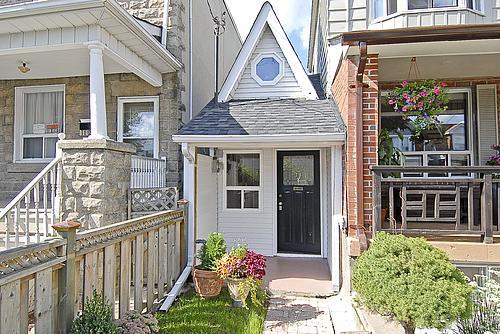
I love the little yard. Together with the backyard, it's ample space to grow one's own herbs and veggies.
Here's the The Tiny Life blog from which that image comes.
ETA: The little house has its own website, writes a commenter! And the house is in Toronto!
But I find this interesting: "Current value: priceless." Does that mean no one lives there? That no one is allowed to buy it?
Also, I notice that the backyard has been paved over. What a shame! From the History page on the website:
That's more like it!
Recommend this post
I love the little yard. Together with the backyard, it's ample space to grow one's own herbs and veggies.
Here's the The Tiny Life blog from which that image comes.
ETA: The little house has its own website, writes a commenter! And the house is in Toronto!
But I find this interesting: "Current value: priceless." Does that mean no one lives there? That no one is allowed to buy it?
Also, I notice that the backyard has been paved over. What a shame! From the History page on the website:
After his wife passed away, [architect and builder] Mr. Weeden, 77 years of age, ... lived in the house for 6 more years, during which time he tended to the vegetable garden in the rear of the house, growing tomatoes, cabbages, Swiss chard, rhubarb and some flowers.
That's more like it!
Recommend this post
Subscribe to:
Posts (Atom)