Showing posts sorted by relevance for query tiny house. Sort by date Show all posts

25 September 2009

Those Darn Homeless and "Affordable Housing"

Seems BC is intent upon locking up people who refuse shelter accommodation. However, as Jody Patterson points out, there are a whole lot of reasons having nothing to do with mental illness to be unpersuaded by shelter amenities.

Then there are the problems of establishing permanent housing, which I discuss further below. (Hint: Affordability isn't the problem.)

About sheltering street people,

sometimes, it's as simple as not being able to bear the thought of lying on a mat in a big room with 70 or 80 other troubled souls trying to make it through the night in noisy, restless fashion. Or about having no place to leave your cart without all your worldly belongings being stolen by the morning, or another night of waiting in line outside the shelter just to find out there are no beds left, by which time all the good outdoor sleeping spots are long gone.

It's about having a spouse and wanting to sleep like a couple, or having a pet that you can't possibly leave outside alone in the cold. When our region's "cold wet weather" protocol kicks in - and believe me, it's damn cold and wet before that happens - only one adult emergency shelter, the one at St. John the Divine, welcomes couples and pets.

Then there's a whole other group of resisters with severe addictions, whose sleep/wake cycles are so completely out of whack that the idea of lying down quietly at night for eight hours isn't even an option.

Some have mental-health issues that keep them out of shelters, although not many in my experience, and certainly not enough to give Coleman the quick street cleanup he's envisioning. There's also a tiny group who would actually choose to live outside no matter what: Modern-day hermits, maybe 32 people in all in our region.


One positive solution is already here, in Vancouver. It has nothing to do with arresting people or having them corralled by police and left at shelters that may have no room for them.

The City of Vancouver has had amazing success with such populations using a new kind of shelter piloted late last year. None of it has required arresting people.

The goal of the project was to lure resisters inside by providing shelter with a difference - locked spaces for carts, couples and pets allowed, a 24-hour TV room to accommodate the sleepless, the dignity of booking another night before you left the shelter rather than having to line up much later in the day and hope for the best.

The empty buildings used for the shelters were pulled together quickly and on the cheap, with an operating cost of roughly $1.5 million for the three-month pilot. All were located in areas where people were already sleeping.

...More than 500 people who'd previously refused to use shelters came inside within a few days of the shelters opening last December.


People who are homeless have as much right to choice and dignity as anyone else. Of the choices they might make, how hard is it to imagine yourself refusing to be separated from your spouse or your pet or your entire worldly belongings?

It's not rocket science to reduce homelessness only to those people who would choose it as a lifestyle (many of whom reject the 'homeless' label).

Temporary measures include permitting and supporting tent cities, and providing serviced parking areas for people whose homes are on wheels (cars, trailers).

Permanent solutions must begin by changing the municipal by-laws that effectively enshrine NIMBYism. In few communities is it possible under current laws for the construction of a village of tiny houses. In my own community, laneway housing is still not permitted, despite Vancouver's recent example. (Regarding the latter, $150,000 to $200,000, which includes BC Hydro servicing, are the costs typically cited for the construction of a tiny house on existing property. The City of Vancouver is allowing these laneway houses only to be rented. Why would property owners bother? The costs cited are absurd. A tiny house can be built for one-tenth the price.)

The tiny house movement has coincided with the green movement. Downsizing is in vogue. Municipal laws and other regulations pertaining to buying property and house construction haven't kept up.

The problem of 'affordable housing' isn't one of lack of innovative ideas for shelter materials, construction and community design. The developers are out there who would build these things.

The problem isn't affordability of the shelters themselves. People in the US are building their own homes for NOTHING, from recycled scraps, from shipping containers, from old railway cars. Others are buying materials for under $3,000. Still others buy their tiny houses pre-built for under $25,000. Then there is the mobile home option: fifth wheels and other trailers. Too many used trailers to count sit unoccupied on RV dealer lots.

In other words, the problem isn't the HOUSING.

The problem is systemic NIMBYism, the failure of municipalities to accommodate changing community needs, the lack of will on the part of politicians at all levels to open their eyes and see where the problems truly lie, and the "I'm all right" attitude that blinds too many residents from seeing the need for change.

The problem is the LAND on which to place the housing, land whose use is not restricted by municipal laws. The problem is ALLOWABLE housing.

The problem has NOTHING TO DO WITH AFFORDABILITY and EVERYTHING to do with keeping 'those people' out.

Recommend this post

Imagine What It's Like

... to have yearned for a tiny place all your own, a tiny house or a trailer, one whose maintenance fits within your budget and where you and your furry companions can live in peace.

Imagine that someone comes forward and says to you: "I'll buy you a tiny house or a trailer; just find a place to put it."

Imagine that, feeling hope for the first time in a decade, you try and you try and you try and nowhere can you find land on which to place a tiny home. No RV pad is available, although there's no shortage of used trailers for purchase. No land is available that hasn't restrictions on the type of structures allowed; houses must be of certain minimal dimensions, they must have this or that amenity, and so on.

Imagine then that you must say to your potential benefactor: "I can't accept your gift of a tiny place. I can find nowhere to put it."

Imagine hope fading.

Imagine that the same someone comes forward and says to you: "Alright, if I can't buy you a tiny house or a trailer, then let me buy you a scooter. Then you'll be able to get about without pain. Just tell me the total cost, including insurance, and I'll send you the money."

Imagine hope rising.

Imagine enthusiastically checking online and deciding with the help of your potential benefactor whether it should be a Honda Jazz or a Yamaha Vino. Imagine scouting out the prices, learning about the licensing and insurance requirements, adding up the costs. Imagine reporting back your findings and the two of you deciding on the Vino.

Imagine the excitement growing, not just yours, but hers too...

Then imagine thinking: "Wait. Consider what you're doing. You don't live in a secure place. This is a high-theft area. There's nowhere to keep your scooter safe: no garage, no locker, no area inside the building. There's no carport, no awning under which your scooter can be kept from 30 to 40 cm snow dumps, no protection from the snow plow when it comes to clear the parking lot. The scooter will be exposed to vandalism and theft and the elements all year-round; and there's nothing you can do about it."

Imagine.

Possession of a scooter depends on relocation to a more secure residence.

Now suppose that word came in the spring of a rare, subsidized, seniors residence. It's one of the few rental places in this province, subsidized and not, that accepts pets.

Imagine someone applying to that development and the applicant being put on a waiting list.

Imagine hope waits.

Recommend this post

28 June 2009

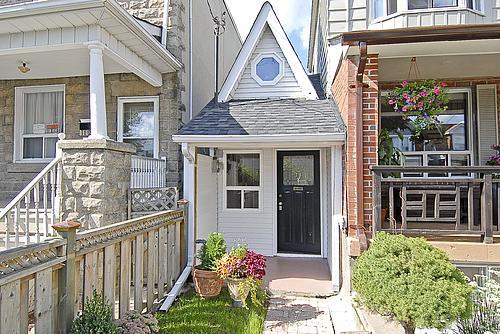
Soooo Cute! Tiny House, Tiny Yard - Updated

This is so cute, tucked snug between two larger homes.


I love the little yard. Together with the backyard, it's ample space to grow one's own herbs and veggies.

Here's the The Tiny Life blog from which that image comes.

ETA: The little house has its own website, writes a commenter! And the house is in Toronto!

But I find this interesting: "Current value: priceless." Does that mean no one lives there? That no one is allowed to buy it?

Also, I notice that the backyard has been paved over. What a shame! From the History page on the website:

After his wife passed away, [architect and builder] Mr. Weeden, 77 years of age, ... lived in the house for 6 more years, during which time he tended to the vegetable garden in the rear of the house, growing tomatoes, cabbages, Swiss chard, rhubarb and some flowers.


That's more like it!

Recommend this post

28 October 2008

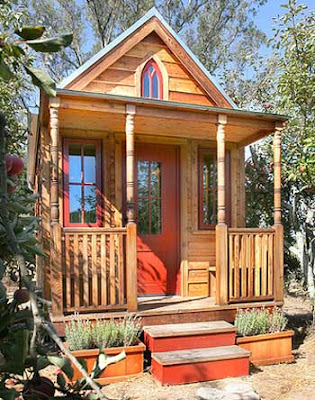
Housing: Dreaming a Tumbleweed house


All I've ever wanted is a tiny house, on a piece of land large enough to grow my own veggies and fruit, a place where no one can tell me I can't keep Kiltie and Brodie.

And everytime I pass by a dilapidated or unused tool shed or garage, I think again of my dream.

Or when a post like the one John wrote today reminds me to visit one of my favourite bookmarks: Tumbleweed Tiny House Company.

Below is a photo of the Epu.

It's 89 square feet, the second smallest model of Tumbleweed homes and the one in which the owner of Tumbleweed lives.

Tumbleweed homes range from 65 to 774 square feet.


Can't describe the yearning I feel to have something like that. My very own little house in which there's no question that I can keep my cats and on land which can ensure there's enough nutritious food to eat.

The cost of land prohibits the dream from coming true.

Even if a similar rental situation came up - e.g., there are one-room, low-income cottages for the 55+ nearby -, the likelihood is strong I wouldn't be allowed to keep my cats, as is the case at Crescent Cottages.

That is a non-starter for people who need the companionship of pets.

So now, as I approach retirement with disabilities which limit my employment prospects, there's no question I'll remain a renter for the rest of my life. And as such I'll always be under threat of having to move, as conditions change according to owners' whims. :-(

Recommend this post

17 March 2008

Associating homelessness with mental illness

Below is an excerpt from the House of Commons Hansard for Question Period, Mar 12-08. The question was a softball lobbed from a Conservative Party member to Tony Clement, Minister of Health, to allow Clement to enter into the Hansard mention of the Mental Health Commission, which was formed last summer.

Mr. Wajid Khan (Mississauga—Streetsville, CPC):
Mr. Speaker, last summer the Prime Minister and the Minister of Health announced Canada's first ever Mental Health Commission. Mental health groups from across the country gave an enthusiastic welcome to this long overdue action to help some of the most vulnerable in our society.

Those who failed Canadians sit on the benches on that side of the House. After years of struggling in the shadows under the previous government, individuals and families dealing with mental health issues can finally count on help from this federal government.

Could the Minister of Health inform the House on how this Conservative government is keeping its promise to help Canadians?

Hon. Tony Clement (Minister of Health and Minister for the Federal Economic Development Initiative for Northern Ontario, CPC):
Mr. Speaker, let me first thank the hon. member for an excellent question. I would say to the House that even in good economic times there are those at risk of being left behind, but Canadians are guided by the values of compassion, kindness and generosity. That is why we created the Mental Health Commission in the first place.

That is why the Minister of Finance, demonstrating those important values himself, announced funding in budget 2008 for the commission to establish five pilot projects across the country to help show the way on how we can help those who are homeless and suffering from mental illness.


I heard Clement's response before visiting the MHCC website and was immediately struck by Clement's associating mental illness with homelessness.

'Homelessness' would be better defined as 'houselessness'. There are those who are labelled homeless who have chosen not to be surrounded by bricks and mortar. Are they therefore mentally ill because they have chosen differently?

Then people who have not chosen houselessness may legitimately feel depressed, stressed, and anxiety-prone. But should that basic, normal survival response be labelled as mental illness? The cynical answer is Yes - for the sake of a robust mental health industry.

One of the many houseless women I met through my work with WISE described how she'd lived for 30 years. It was near the top of a mountain in the Yukon, in a tiny one-room shack whose walls and roof were of ill-fitting timber and other natural products, whose washing facilities and toilet was nature itself, and a shovel. She cooked by fire and whatever food needed storing she kept frozen in snow or dried. Nature was her food source.

Each morning this woman, Anne, stepped out from her home on the mountain and saw nature's expanse laid out before her. "I felt so rich," she told me, with a sigh and eyes warming in remembrance.

Another woman, also from the Yukon, was still houseless - and loving it. The owner of a large acreage had allowed her to set up her tent on a small section of the property. This gave her an address and with that, she was able to obtain part-time employment. The job was just a few hours per week, but that's all she wanted. It was her sole source of income and brought in $6,000 per year. According to her, with that $6K she had more than enough to live the life she wanted. She'd equipped her well-insulated tent with a cookstove and had use of the main house's bathroom facilities.

The first time I saw this woman, Barbara, she'd come to participate in our Scarlet Letter Campaign workshop. She arrived on her scooter, dressed up in full black leather and helmet. She didn't look 'poor'. Her clothing was high-quality, bought at used clothing outlets, and she carried herself with confidence.

These women take a different view of life than the larger society which surrounds them. The first - whose poems have been published and won awards - now lives in Kamloops and misses her life in the Yukon. Now she's on the system, has been diagnosed with a mental illness, etc., etc., etc. The second woman gets a kick out of baffling people. She too gets stereotyped and has been labelled mentally ill.

How these women got to their houseless state is one question, but it's not the most important one. The most important question is how they choose to continue their life. Ancillary questions are how society judges the women's choices, by what right it does so, and how it treats the women who make them.

NB: The names are fictitious.

Recommend this post

02 April 2010

Status of Women Minister Buys $880K Ottawa House

... and mortgages it for the full purchase price of $880,000. No money down. House was bought in November.

Helena Guergis, Minister of Status of Women Canada, gets a salary of $157,731. That includes a $56,637 top-up for her Cabinet position. As far as I know her husband, one Rahim Jaffer, is currently unemployed. He will begin receiving a lucrative pension at age 55, thanks to his brief career as a Member of Parliament.

Normally I consider the personal lives of MPs to be off-bounds, but this case points to two issues that I think cross over into the public sphere.

First, what was the woman thinking?! Has she no sense of economy? Has she no clue what it's like to maintain a budget? Even to consider buying a house that's six times one's annual salary, one that's subject to the fickle political winds of change, seems ludicrous to me.

And I have to laugh at the irony, given something that happened to me a few days ago. It highlights the stark differences between life for many women in Canada - women for whom Status of Women Canada is supposed to be a champion for change - and those few like Guergis.

I live in the lowest decile category of income. I've a lifelong dream of owning my own tiny home, on a tiny piece of land. To keep the dream alive, I occasionally visit mls.ca, run a search, and see if anything comes up. Then I check the ads out and run a bunch of 'what ifs' in my head. That's how I keep the dream alive.

A few days ago, I found an ad for a 5th wheel, sited in a mobile home park about two hours by car north of here. Asking price: $11,500. I contacted the realtor and we exchanged emails back and forth. Right away, I contacted friend Daphne; we discussed the pros and cons via emails and one Skype call. We talked and talked some more. I agonized over the possibilities. Ultimately I decided against, before ever going to see the trailer.

Even assuming I could get the price down to under $10,000, it would take more than half of my remaining savings; and my income, beginning in July when I turn 60, will be approximately $8,000 per year. The issues to be considered weren't just the price of the trailer, but the pad rent ($334/month), the security of the pad (might the owners be thinking of selling?), security in the other sense (is it a safe area?), the maintenance costs (does the roof need replacing? if not now, when? what else needs fixing/maintaining?), heating, the cost of products locally (is it more expensive to buy there than here?), accessibility to shopping and services for someone with no vehicle, and so on.

Which brings me to my second point...

How can Guergis possibly relate to the problems women like me face when she has no clue how to manage her own finances? And what the HELL is she doing overseeing any government Ministry, let alone the Status of Women Canada?

I ask, because unless there's a rich daddy somewhere, Guergis & Co. will be heading to bankruptcy court in the not too distant future.

Recommend this post

04 June 2009

About that 30% Threshold to Obtain Mortgages

To obtain a mortgage, the standard income to total shelter expenditure - mortgage, property tax, maintenance, phone/internet, insurance - is 30 percent. It has been 30 percent for at least the past four decades.

Why? Why that threshold and why has it never been changed?

Times are not what they were forty, or even ten, years ago. People don't all have the same priorities or want the same lifestyles. A growing number of home owners do, and are getting by, on paying 50 percent or more of their income on shelter expenses. Renters pay upwards of 70 percent of their household income on shelter now.

So what is the rationale behind mortgage lenders' carved-in-stone 30 percent income to shelter expense threshold? Why are people refused a mortgage if they would, without hesitation, pay more of their household income, say the 50 or 70 percent they are already paying, toward preserving a roof over their heads, but one that they actually own?

To me there's something extremely elitist, not to mention unrealistic given today's market, about that threshold.

First, consider its originators and perpetuators: certain haves who cannot conceive of a lifestyle other than their own, people who cannot conceive of anyone who pays the majority of her household income on shelter as other than a person who is destitute or hard-done-by.

Well, here's a message to such haves: Not everyone considers travel, new clothes every season, dining out, or cottage or vehicle ownership as essential. Some of us are quite content - or would be, if we had a chance! - to own a tiny house on a bit of land in a beautiful spot and leave the rest of the world and its trappings and its lavish, monied values behind.

Second, the 30 percent threshold imposed from on high serves not only to broaden the gap between the rich and the poor, or the propertied and the non-propertied, it entrenches and deepens class divisions.

Which leaves me wondering... Perhaps that's why the threshold has never been changed. It does more than maintain the status quo, it increases the social stature of those already better off. In other words, the threshold serves those with the power to preserve it.

Recommend this post

11 July 2009

The colours take my breath away

They surround a shed which could as easily be converted into a tiny house. What a gorgeous setting! Sigh...


Recommend this post

21 January 2010

UPDATE 2: Michael Ignatieff's Facebook Townhall

[Re-worded my question... Which never saw the light of day except here. Predictable and depressing that is.]

Here is was my question for Michael Ignatieff.

Question: "Creative, inexpensive - even cheap - shelter for permanent housing, using new design techniques and materials could quickly and substantially reduce Canada's homeless numbers and permit more choice for people of low income. These designs exist now and are part of the tiny house movement, yet such solutions are blocked, time and again, due to outdated municipal laws. Do the Liberals have a federal housing strategy and if so, how does it encourage municipalities to be more inclusive and more open to alternative housing options?"

According to Ignatieff's Facebook page, people are supposed to RSVP at a specified site. Tried that. Canna see how I'm to RSVP. What am I missing?

ETA: OK, worked out the RSVP thingie. My NoScript extension on Firefox needed tweaking.

Recommend this post

01 March 2009

Affordable Housing: It's the land, you fools!

UPDATED. More tiny houses, including this one being built cost free.


For years, good ideas have been circulating on the kinds of structures which could be used to house people of low-income. Or people who simply want to reduce their carbon footprint.

The problem has never been about how to create affordable shelter. It's been about where to place it.

Land needs to be made available. Governments could release some of what they own and acquire more land from private sources - such as TimberWest which has 54,000 hectares of Vancouver Island it's looking to sell. NIMBYism is the thornier issue. Apparently, people of low income are dirty, lazy, shiftless thieves and liars, and they bring down the value of real estate.

ETA: Yet another issue is the propensity of the owners of mobile home parks to sell off their land for development.

Imagine if someone were able to build one of those cost-free tiny houses. Provided they could find a vacant MHP lot (one more problem), the pad rent would be substantially lower than what they pay for rent elsewhere. Those tiny houses consume little energy for heating or cooling, so the costs above rent would again be less than what most people would pay in other accommodation.

Recommend this post

03 June 2009

UPDATE: $1,500 Homeless Home Project

... found a home. But there's a problem concerning their being used as homes.

From my March 2nd post:

Remember the $1,500 tiny houses that students of the Emily Carr Institute designed for an assignment given them by instructor Christian Blyt? Well for several months the project itself was homeless.

The struggle for the Home for Less Project to be adopted by communities facing a homeless problem couldn't have been more ironic. No Lower Mainland municipality would take them, despite the urgent need for affordable temporary and permanent housing and despite the inclusive philosophy behind the project.
“The main objective ... was a form of three-dimensional communication,” says Blyt. “We wanted to show that with very limited resources, you can create homes for these citizens, and I keep stressing citizens because they are citizens with rights just like the rest of us.”

Now these 64 square-foot houses have found permanent residence.

"Home for Less Project," wrote Blyt in an email to me this morning, "has found a permanent home on Bowen Island through the efforts of the Bowen Community Housing Association and a private citizen that will be donating land where the units will be placed in the beginning of April."

Thank goodness for the volunteer community, grassroots organizing, Mr. Blyt and his students! Had we to depend on government to get the job done, we'd be waiting years and likely by that time, the situation would have grown worse.

TODAY: All of which sounds wonderful, doesn't it? I would be thrilled to live in one of those tiny homes! But then there is this:

While the houses were originally slated to house a few of the Island's twenty-plus homeless people, their arrival was met with scepticism, as many residents worried the mini houses would attract homeless people to the Island.

According to Richard Best of the BCHA the houses will remain empty for the foreseeable future, though they will serve to educate islanders about the need for more affordable housing.


From hope to despair in the space of a single sentence.

Why are people with money or property so afraid of people without it? All any of us want is a place to call our own and a community that respects our right to live a dignified existence.

Recommend this post

07 April 2009

Aaaawwww ... Cute Alert!

No, it's not a cat. Not a dog. Not a bunny. Not a chimp. Not any cute furry critter.

It's an adorable house on its own tiny piece of land which is selling for the whopping price of $5,000. That's right. FIVE THOUSAND dollars.

Not only is it cute, but this little one-bedroom house was built around 1880 and is under the protection of the Historic Landmarks Foundation of Indiana.


Alas, there appears to be nothing like it in Canada.

Sigh... I want my own little place so badly it aches.

(Click the photo and you can search for other historical properties across the US.)

Recommend this post

25 December 2008

Daphne's Paid Work

OMG!

List my paid-for work? Who started this?

Here goes:

- Blueberry picker and packer
- Bean picker, no packing
- Childminder
- Cranberry cleaner and packer (the women who worked there were jealous of my long painted finger nails and gave me a hard time...sheesh!)
- Gem cutter. (Yup, I cut and polished tiny ovals of jade, tiger eye and other semi-precious stones.)
- Retail Sales Clerk at a Duty Free Shop in a Canadian international airport
- Manager of the same Duty Free Shop supervising ten people; I was 18 years old
- Cheque writer for an insurance company in the claims department
- Short order cook for a small mining outfit
- Scrap truck driver/fork lift operator
- Classified Ads taker and Assistant to Display Ad Editor for a community newspaper
- Accounts payable/receivable Clerk in a company that manufactured steel suspension springs for large transport trucks.
- PayMaster at a trucking outfit
- Labourer for an auto seat cover manufacturer
- Night school secretary
- Pizza maker/store manager
- Manager/programmer for a Senior Citizens Center
- Director for summer programs catering to other-able-ed children and adults
- Counsellor and extra curricular activities Programmer for other-able-ed children
- Executive Director for an association for other able-ed children and adults which offered a pre-school, operated a garage station, a sheltered workshop, a retail outlet and a transportation system
- Grocery store cashier
- Residential counsellor: live-in "co-worker" at an experimental village...... long story.....
- Special education swim instructor and lifeguard
- Chief, Vocational, Continuing and ABE Instructor for a community college (no, not all at once.)
- Night school secretary for same
- Equipment organizer and operator for same
- Educational Planner for same
- Special Needs Co-ordinator/Counsellor for same
- Coffee shop co-ordinator for same
- Owner/operator of silk-screen printing business
- Sales associate for another screenprinter
- Labourer in a hot house that grew long English cucumbers
- Gardener's assistant
- In-house commercial Baker for convenience store
- Enumerator for the last door-to-door collection of information to register citizens for federal elections
- Child care worker for "hard to place" teenage girls
- Case worker/life skills trainer for a brain injured individual
- Basic construction carpenter
- Carpenter's assistant
- Bus depot clerk
- Self-employed Counsellor for other-able-ed children and adults
- Life skills worker in a home for semi-independent women
- Social activist
- Facilitator for a family caregivers support group
- Respite person for in-home caregivers

Recommend this post

28 October 2008

More Tiny Houses - for $1,500

The problem with a Tumbleweed house is that even the 65 square foot model is over $36,000, plus shipping.

Well now I learn that early this year students at the University of British Columbia's Emily Carr Institute designed and built four houses, each unique, each 64 square feet, and none more than $1,500.

Unlike the Tumbleweed models, these little houses don't have their own toilet or shower facility. Instead, they're designed with communal living in mind. For example, a cluster of them might be built around a central bathroom and laundry facility.

Michael Johnson, one of the students who worked on [one of the houses], was surprised how fiercely the homeless citizens he met wanted to maintain their autonomy.

"Some of them weren't homeless because of a drug addiction, they weren't homeless because of anything. They just ran completely out of luck and out of money and out of all of the normal safety nets that catch people," he said. "A number of the people, while they appreciated what the shelters were doing, they felt that, to some extent, their individuality was lost. And speaking to some of the social workers, it was the loss of individuality that proved to be the biggest hurdle to overcome toward rehabilitation."

The portion I highlighted cannot be emphasized enough. It only surprises me how much most people don't get that those who are homeless desire their autonomy as much as anyone. Shelters deprive them of that.

As for the little $1,500 houses designed by the students, the problem comes down again to land. And because they are so low cost and residents would share bathroom facilities, very likely NIMBYism too would rear its ugly head.

Recommend this post

23 March 2009

Want to Downsize, Get Back to Basics?

Then you may be interested in this new online journal which focuses on the "small living" movement. I subscribed to its feed the moment my eye fell upon this adorable brick house tucked away in a meadow.

Until very recently, the concept of living in a space 500 sq. feet or less was definitely contrary to the American mainstream in all but the most dense of cities. In fact, from the 1950’s onward, the American home seemed to be ever increasing in size and grandiosity with little regard to the costs to either individuals or the environment....

It wasn’t until the recent decline in housing values, failure of the sub-prime housing industry, and subsequent impact to the broader U.S. and world economies that most people were willing to consider any solution out of the norm when it came to housing options. Now, however, there is an increasing amount of media attention on any form of cheap housing solution. Older inner city homes, yurts, tiny houses on wheel, houseboats, RV’s, log cabins and the like are now featuring on the evening news and regular pieces in the New York Times.

... [T]he small shift in mainstream mindset toward more modest housing options has been exciting to many members of the small home movement. But we realize that there’s a long way to go in terms of right-sizing the “American Dream”. In the meantime, the group of us on SLJ thought it would serve a useful purpose to have a website where we could regularly release articles that might prove useful to people interested in downsizing their lives to more manageable proportions.

Jump over to the Small Living Journal and have a look.

Recommend this post

30 December 2009

How to Game Canadian Parliamentary System

... in five easy steps.

1. Promise 'em anything. While the Official Opposition, complain about the unfair voting system, lax election laws, rules discouraging people from voting, lack of government transparency, Senate appointments...

2. Win by a plurality under said unfair voting system, lax election laws, rules discouraging people from voting, lack of government transparency, Senate appointments... Do not legislate improvements.

3. Write a 200+ page book on how to disrupt House of Commons (and Senate) committees. Make sure all MPs follow it religiously.

4. Control the message: all leaks/messages must be authorized by PMO, whisper Ottawa news in ears of media buddies first, zip your loose-tongued MPs - have them pose as potted plants.

5. If, despite following the first four steps, you find things getting a little too hot for you, prorogue Parliament.

Remember, the Canadian Parliament is no longer for the purpose of governing - designing and getting key legislation passed, studying vital issues in committees, or MPs representing their constituents. No, it's about which white ageing male can grab and wield power the longest and the men who will trade whatever integrity they've left in order to share in a tiny portion of it.

Recommend this post